
Money Train 4 slot review (2026): how the game works and what the Money Cart Bonus really does
Money Train 4 is a very high-volatility video slot from Relax Gaming, released on 20 September 2023 and still widely available in 2026. It runs on a 6×6 Scatter Pays grid, with stakes from €0.10 to €6 and a headline maximum win of 150,000x the bet. The gameplay is built around two ideas: clusters of symbols that pay anywhere on the grid, and a feature ecosystem where special “character” symbols can dramatically change the value of a bonus round.
Core setup: grid, betting range, RTP versions, and what “very high volatility” means
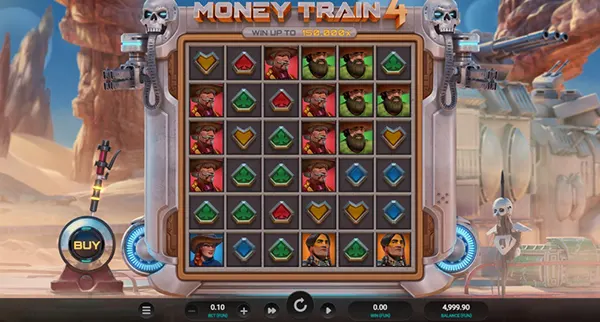
Money Train 4 uses a 6×6 grid with Scatter Pays, so there are no fixed paylines. Wins come from landing enough matching symbols anywhere on the grid, and the game’s own information panels make it clear that certain symbols require higher counts to pay. This layout produces a steady stream of partial matches, but meaningful payouts tend to be uneven, because the game is built to spike rather than to drip-feed returns.
In 2026, the main figures most players check first are easy to verify: the stake range is €0.10 to €6, and the maximum win is 150,000x stake. The RTP is commonly presented as 96.1%, but there is also a 94% RTP version that is frequently used by UK-facing casinos. If you care about long-run value, the practical point is simple: the RTP setting is not a minor detail, and you should confirm the exact figure inside the game before committing to long sessions.
Relax also classifies the slot as very high volatility, and you will feel that quickly. “Very high” here isn’t marketing fluff: it’s a warning about variance. You can see long stretches where the base game pays little, then a feature interaction lands and the session outcome changes in a handful of spins. If your aim is predictable bankroll pacing, this is not that kind of slot.
How wins form on Scatter Pays, and why the grid size changes the rhythm
Because the grid has 36 positions, the game can form multiple separate wins on the same spin, and that can look busy even when the total payout is modest. The trade-off is that the requirements for many symbols are relatively strict: you need a sizeable portion of the grid to align before the game pays anything notable. That design keeps the base game tense, but it also increases the “all or nothing” feel.
Another rhythm change comes from the way Scatter Pays interacts with special symbols and features. In a paylines slot, you often know immediately whether a spin is dead. Here, a spin can look promising simply because many matching symbols are present, even if they are still below the threshold required for a payout. This can be entertaining, but it can also encourage players to overestimate how often the game is about to pay.
The healthiest way to approach the grid is to treat it like probability, not like momentum. A near-threshold screen does not improve the next spin’s odds in any meaningful way. The only time the “state” of the game matters is when you are inside a feature with sticky symbols or reset mechanics, where the rules explicitly carry progress forward.
The Respin feature: what it does, when it triggers, and what it can realistically deliver
The Respin feature is the main base-game event that can change a spin’s outcome without triggering the full bonus round. It can trigger at the end of a base spin and focuses on building a large screen of one chosen symbol. This feature matters because it’s one of the few moments where the game briefly shifts from chaos to a more controlled “fill the grid” chase.
In practice, the Respin feature works best when the chosen symbol already has a strong presence on the triggering spin. That gives the mechanic a head start: more sticky positions, fewer blanks to fight against, and a higher chance that new symbols land often enough to keep the feature alive. When the start is weak, the feature can end quickly and feel like a brief tease rather than a payoff moment.
It’s also important not to confuse it with the Money Cart Bonus. Respin is a separate mechanic with its own rules and ceiling. It can produce meaningful wins, but the truly extreme outcomes are more closely associated with the main bonus round’s special symbol interactions, where values can be collected, transferred, upgraded, and multiplied over multiple spins.
Step-by-step: sticky symbols, blanks, and multipliers in the Respin sequence
When Respin triggers, the game selects the symbol that appears most often on the grid. Those symbols become sticky, and the game awards respins where only the selected symbol, multiplier symbols, and blanks can appear. The goal is straightforward: keep landing at least one new relevant symbol so the feature continues and the grid grows denser.
Multiplier symbols do not stick, but they add their value to a running multiplier that applies at the end of the sequence. This is the main lever that turns a “nice fill” into something worth remembering. Without multipliers, even a solid symbol count can land in a middling range; with multipliers stacking, the same final screen can jump sharply.
The feature ends when the remaining open positions resolve into blanks without extending the sequence. In other words, you are effectively playing against silence: the moment the grid stops gaining new material, the feature shuts down and pays whatever it has built. That’s why Respin outcomes can vary wildly even across two sequences that look similar at the start.
Money Cart Bonus: trigger conditions, expanding rows, and the real purpose of special symbols
The Money Cart Bonus is the headline feature and the reason most players seek out Money Train 4. It triggers by landing three or more Bonus symbols, and persistent versions of certain symbols can help contribute to triggering the bonus as well. Once you are in, the structure changes: you begin with a smaller field and can expand it by unlocking extra rows, which directly increases the room available for value-building interactions.
The spin economy is deliberately tight. The bonus starts with a small number of spins, and the counter resets when new symbols land, so the round lives or dies based on whether the grid keeps “receiving” new pieces. This is the key to the game’s volatility: a bonus that stalls early can be disappointing, while a bonus that keeps landing symbols can snowball into a very different result.
In 2026, many casinos also offer feature buys for this bonus. The best-known options are a 100x stake buy for the standard entry and a 500x stake buy designed to guarantee at least one persistent symbol inside the bonus. These options change how quickly you reach the feature, but they don’t remove the underlying variance: a bought bonus can still end quickly if the grid does not continue to fill.
What the feature symbols actually do: collecting, paying, upgrading, and targeted doubling
The special symbols in Money Cart Bonus are not decorative — they exist to move value around the grid. Collector-type symbols gather values from other bonus symbols and consolidate them, while payer-type symbols distribute value outward. The point is not just to land high values, but to create a network where values are repeatedly gathered and redistributed so the same “money” is counted more than once across the round’s life.
Persistent symbols are the most influential because they repeat their effect over multiple spins. A persistent collector or payer can turn an average-looking bonus into a compounding system, simply by being present early enough to act again and again. This is also why the 500x persistent feature buy is often described as a different risk tier: you are paying to force the presence of a repeating engine, not to guarantee a big win.
Other symbols are designed for sudden leaps. Sniper-style symbols can double the values of multiple targets, and “dealer” style symbols can convert plain bonus symbols into feature symbols that act immediately. When these arrive at the right time — after value has already accumulated — they can create an abrupt step-up in the final payout. When they arrive too early, they may have little meaningful value to multiply or convert.